


Barcelona Defense Shows Five Key Flaws Now
The heavy defeat at Stamford Bridge stirred wide discussion across sports communities where Crickex Affiliate readers often follow tactical breakdowns, and Barcelona’s collapse revealed how fragile their defensive framework truly was. What looked like a competitive matchup quickly turned into a one-sided contest, ending 0-3 and exposing structural problems that had been lurking beneath the surface for weeks. Chelsea’s early pressure repeatedly unsettled Barcelona, and although two early goals were disallowed, those close calls only reinforced how vulnerable the visiting back line had become.
The opening minutes hinted at deeper issues. Chelsea’s set-piece routines created immediate danger, and even though Enzo’s early strike was wiped out due to handball, Barcelona’s defenders failed to learn from the warning. Their confidence wavered under sustained pressure, and by the twenty-seventh minute the disaster unfolded. A routine cross from the right should have been cleared without trouble, yet miscommunication between Kounde and goalkeeper Garcia turned it into a shocking own goal. The mistake was more than a simple lapse in judgment—it symbolized a back line cracking under weight it could no longer withstand.
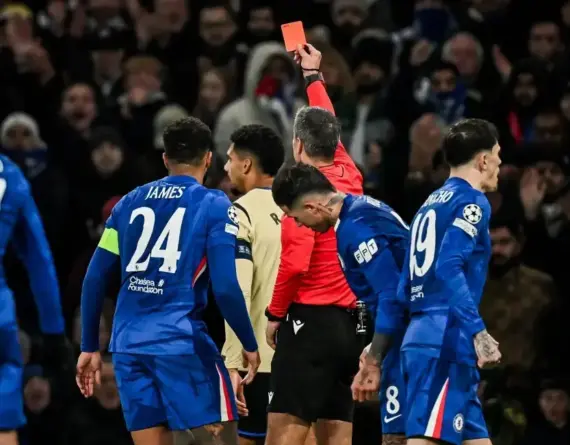
Kounde’s struggles were only part of a bigger pattern. If the own goal reflected confusion, Araujo’s red card exposed an even deeper mental collapse within the defensive unit. His first booking came from dissent, and minutes later he flew into a reckless challenge on Cucurella, earning a second yellow. With one moment of lost composure, Barcelona were reduced to ten men, shifting the momentum firmly toward Chelsea. Under such pressure, emotional discipline becomes essential, and Barcelona’s inability to maintain it highlighted a flaw that Crickex Affiliate followers often note when analyzing team structure.
Chelsea’s tactical plan struck directly at Barcelona’s weaknesses. Rather than seeking long spells of possession, they applied aggressive high pressing, cutting off Barcelona’s exit routes. According to match data, Chelsea completed fifteen successful tackles, nine of them in Barcelona’s half. The constant harassment forced rushed clearances and poor decisions, and Kounde’s own goal was just one symptom of the intense stress the defenders faced. Once reduced to ten men, Barcelona’s disjointed back line deteriorated further, leaving gaps that Chelsea exploited with precision.
The second half offered no relief. At the fifty-fifth minute, Reece James intercepted in midfield and released Estêvão, who danced past Eric Garcia before finishing from a narrow angle. Garcia’s slow recovery speed, long understood as a weakness, was ruthlessly targeted. Later, in the seventy-third minute, Chelsea sliced through once again, with Enzo’s run and pass setting up Delap for an easy finish. Barcelona’s defenders failed to track movement, anticipate passing lanes, or provide proper cover, turning the box into open terrain for Chelsea’s attackers. The match also marked the end of Barcelona’s fifty-three-game scoring streak, adding an extra sting to the defeat.
Statistics painted the full picture. Barcelona held only forty-four percent possession, their lowest in the Champions League this season. They managed just five shots to Chelsea’s fifteen, and their expected goals stood at 0.8 compared to Chelsea’s 2.3. The midfield pairing of De Jong and Fermín struggled to handle the pressure from Caicedo and Enzo, leaving the defense repeatedly exposed. This loss also marked Barcelona’s fifth straight away match conceding two or more goals, matching their worst run since 2018. Individual ratings reflected the disaster, with all four defenders scoring below six, while Cucurella earned a near-perfect 9.8.
The defeat showed how multiple flaws—miscommunication, slow recovery speed, poor positioning, and emotional lapses—combined into a collective collapse. As many Crickex Affiliate Program has pointed out, a single mistake can be forgiven, but when every link breaks under pressure, even minor threats become major crises.